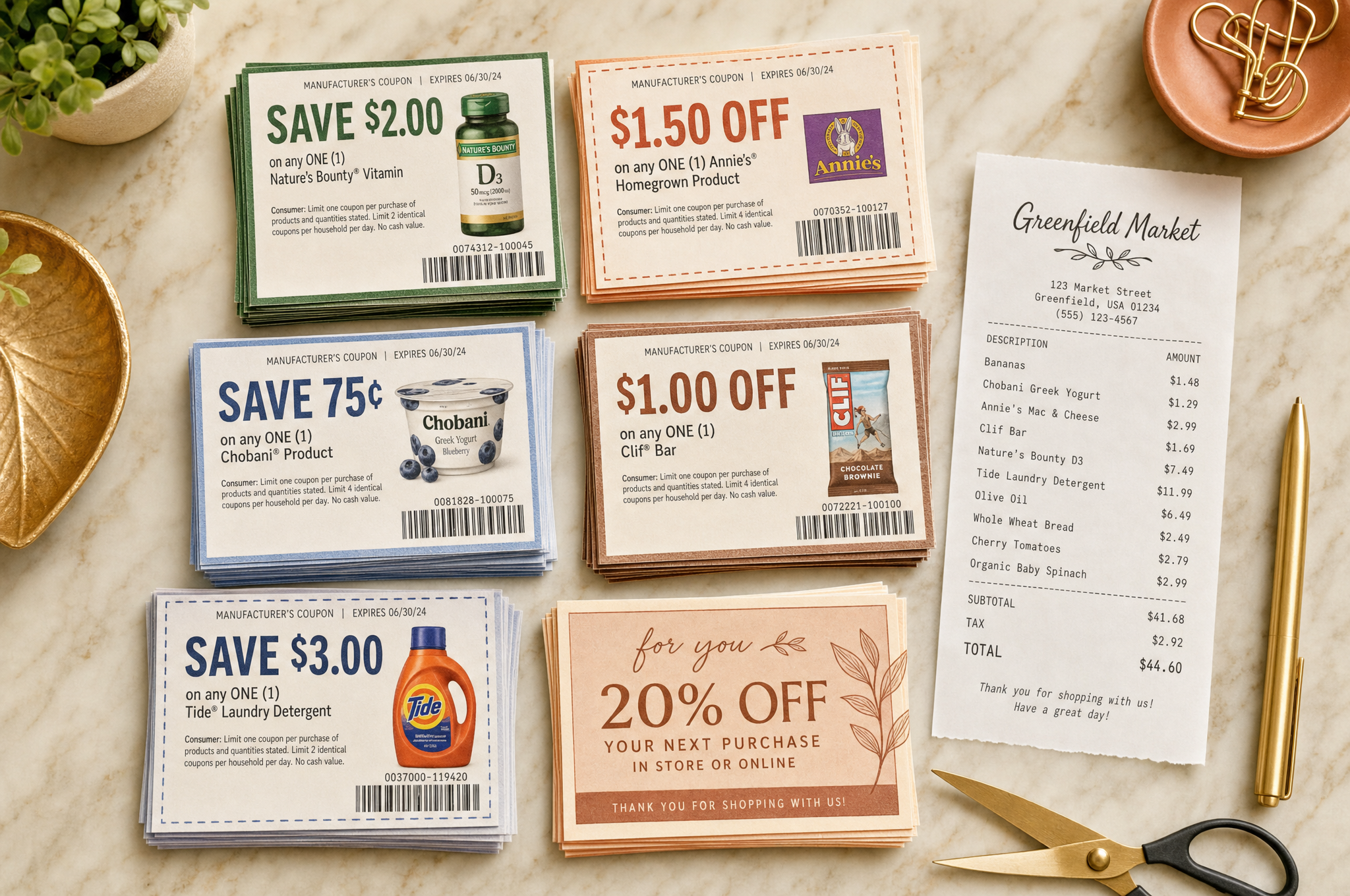
The woman ahead of me in line at Target last month had a binder. An actual three-ring binder, tabbed, with baseball card pages holding coupons sorted by aisle. She spent forty-five minutes at checkout and saved $73. The cashier looked exhausted. The people behind her looked murderous.
I leaned over to my husband and whispered, "She's doing it the hard way."
Here's the truth about coupon stacking in 2026: it still works, and it can still save you serious money. But the landscape has shifted dramatically since the "Extreme Couponing" era. Digital coupons have replaced most paper ones. Store apps have replaced the binder. And the stacking rules — which coupons you can combine and which you can't — are different at every single chain.
Let me walk you through what actually works right now, store by store, so you can stack without spending your life on it.
The basics: what "stacking" means
Coupon stacking is combining multiple discounts on a single item. The classic stack is:
- A manufacturer coupon — issued by the brand (Procter & Gamble, Kraft, etc.) and accepted at any store that carries the product
- A store coupon — issued by the retailer (Target Circle, CVS ExtraBucks, etc.) and only valid at that store
When you use both on one item, you're stacking. The manufacturer coupon reduces the price, then the store coupon reduces it further. On top of that, if the item is already on sale, you're getting three layers of savings: sale price + manufacturer coupon + store coupon.
This is the foundation. The specifics, though, have gotten complicated.
What changed in 2026
If you last couponed seriously five years ago, here's what's different:
- Paper coupons are rare. The Sunday newspaper insert is mostly gone. Most manufacturer coupons are now digital, loaded to store loyalty accounts or available through apps.
- "One coupon per transaction" rules are stricter. Many stores now limit digital coupon use to one per item per day, tracked through your loyalty account.
- Target merged Cartwheel into Circle. All Target coupons now live in the Circle app. You can stack a manufacturer coupon (digital or paper) with a Circle offer.
- Dollar-off-total coupons still stack. Store coupons like "$5 off $25" can often be combined with item-specific coupons, but each store has its own rule.
Store-by-store stacking guide
Target
Target is still the best national chain for coupon stacking. Here's what works:
- Sale price + Target Circle coupon + manufacturer coupon — all three stack on a single item
- Circle offers are per-item — you can use one Circle offer and one manufacturer coupon per item
- Target gift card promotions stack with coupons — when Target runs "buy 3, get a $10 gift card" deals, you can still use coupons on each item
- Target's price match policy still applies — you can price-match a competitor and still use coupons
The catch: Target's app only lets you load one manufacturer coupon per item per day. If you have two different manufacturer coupons for the same product, you can only use one per transaction.
CVS
CVS is the drugstore stacking champion, but you need to understand ExtraBucks. Here's the stack:
- Sale price + manufacturer coupon + CVS store coupon (from the app or weekly ad) + ExtraBucks offer
- ExtraBucks are like store credit that prints after your purchase — you use them on your next transaction
- The trick is "rolling" ExtraBucks: use them to buy items that generate new ExtraBucks
I cover the full CVS strategy in my drugstore deals guide, including how to split transactions to roll ExtraBucks effectively.
Walgreens
Walgreens uses Register Rewards instead of ExtraBucks, and the rules are slightly different:
- You can stack a manufacturer coupon with a Walgreens store coupon
- Register Rewards are essentially manufacturer coupons, so you can't use a Register Reward from one product to buy the same product again
- You need as many items as you have coupons — Walgreens counts Register Rewards as coupons, so you may need "filler" items
Grocery stores
Stacking at grocery chains varies wildly. Most regional chains (Kroger, Safeway, Publix) allow:
- Sale price + digital manufacturer coupon (loaded to loyalty card) + store coupon (from the weekly ad or app)
- Some, like Publix, still accept competitor coupons — check your local store's policy
- Dollar-off-total coupons (like "$10 off $50") generally stack with item-specific coupons
The golden rule: always ask the cashier or check the store's website for the current coupon policy before you plan a big stacking trip. Policies change without notice.
What doesn't work anymore
Save yourself the frustration — these strategies are dead:
- Stacking two manufacturer coupons on one item. Never allowed, and digital tracking makes it impossible now.
- Coupon overage. Most stores now adjust coupon value down to the item price. You won't get money back.
- Using expired coupons. Some stores used to accept these within a grace period. Almost none do now.
- Photocopying printable coupons. Each printable has a unique code. Copies will be rejected and may flag your account.
The time-to-savings ratio
Here's where I'm going to be honest with you. Coupon stacking takes time. The question is whether the time investment is worth the savings — and that depends on your situation.
If you enjoy the process (some people genuinely find it fun, like a game), the savings are real. I save about $30-50 per grocery trip with moderate stacking — maybe 30 minutes of prep per week.
If you find it stressful, focus on the highest-return strategies instead:
- Buy items at their rock-bottom sale price — this alone saves more than any coupon strategy
- Use rebate apps for effortless post-purchase savings
- Stack only when the savings are significant — don't spend 20 minutes chasing a $0.75 coupon
The 80/20 of Coupon Stacking
80% of your savings come from three things: buying at the sale-cycle low, using one manufacturer coupon on top, and using store rewards programs (Circle, ExtraBucks, Register Rewards). The other 20% — the binder-level strategies — takes 80% of the effort. Focus on the first 80%.
A practical stacking trip, step by step
Let's say Crest toothpaste is on sale at CVS for $3.49 (regular $5.49). You have a $2 manufacturer coupon and there's a $2 ExtraBucks offer.
- Sale price: $3.49
- Minus manufacturer coupon: -$2.00
- You pay: $1.49
- You receive: $2.00 in ExtraBucks
- Net cost: -$0.51 (you made fifty cents)
That's a "money-maker" — the holy grail of couponing. It doesn't happen every week, but when sale cycles, coupons, and store rewards align, it's possible.
Just remember to use those ExtraBucks on your next trip, or they expire. I set a phone reminder for the expiration date.
Start simple
If you're new to stacking, don't try to master every store at once. Pick one store — the one you shop at most — and learn its app, its coupon policy, and its rewards program. Once you're comfortable there, expand.
The goal isn't to become a coupon professional. It's to save money efficiently so you can spend your time on things that matter more. Stack when it's easy, skip it when it's not, and always buy at the bottom of the sale cycle first.