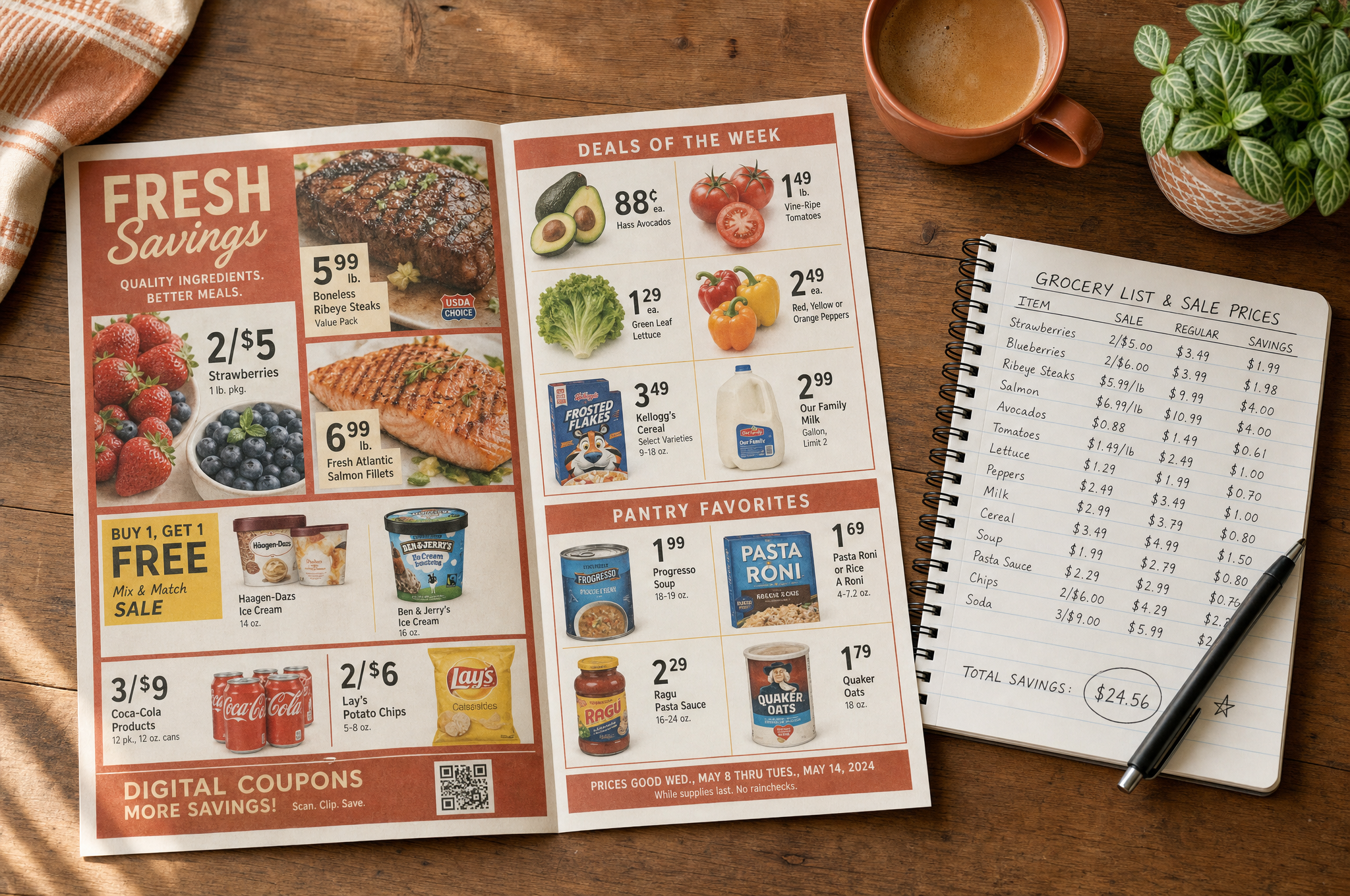
My neighbor Sharon came over last Tuesday with a grocery receipt and a question I get a lot: "How do you know when to stock up? I feel like I buy things on sale and then they're cheaper the next week."
She's not wrong to feel that way. Most people shop sales reactively — you see a discount, you buy. But grocery stores don't run sales randomly. Every major chain operates on a predictable pricing cycle, and once you understand the rhythm, you stop guessing and start buying at the actual lowest price.
Here's the method I've used for over a decade. It takes six weeks of light tracking, and after that, you'll never overpay for your regular groceries again.
What You'll Learn
How grocery sale cycles actually work
Most major grocery chains operate on a 6-to-12 week pricing cycle. That means any given product will hit its lowest price — what couponers call the "rock bottom" price — once every six to twelve weeks. The rest of the time, it's at regular price or at a mediocre "sale" that's really just a small markdown.
Here's the key insight: stores want you to think every sale is a good sale. The Wednesday circular says "Save $2!" in big red letters, but that $2 off might be from an inflated regular price. The real deals — the ones worth driving to the store for — happen when the price drops to the bottom of its cycle.
Different categories cycle at different speeds:
- Meat and poultry: 3-4 week cycles (frequent but smaller discounts)
- Pantry staples (peanut butter, pasta, cereal): 6-8 week cycles
- Cleaning products: 8-12 week cycles (deeper discounts, less frequent)
- Seasonal items: Annual cycles tied to holidays and seasons
The 6-week tracking method
Here's the practical part. You don't need a spreadsheet or an app — a small notebook works better. I still use a $2 composition book from the drugstore.
Week 1-2: Build your list
Write down the 20-30 items you buy most often. Not everything in the store — just your regulars. For my family, that's milk, eggs, chicken breasts, ground beef, pasta, pasta sauce, peanut butter, cereal, bread, cheese, yogurt, bananas, apples, onions, potatoes, toilet paper, paper towels, laundry detergent, dish soap, and about ten more.
For each item, write down what you think is a good price. This is just your starting guess — you'll refine it.
Week 2-6: Track the actual prices
Each week, grab the store circular (or check the app) and write down the sale price for each item on your list. If the item isn't on sale that week, write down the regular price. After six weeks, you'll have a column of prices for each item that looks something like this:
| Item | Wk 1 | Wk 2 | Wk 3 | Wk 4 | Wk 5 | Wk 6 |
|---|---|---|---|---|---|---|
| Peanut butter (18oz) | $3.49 | $3.49 | $2.99 | $3.49 | $2.49 | $3.49 |
| Chicken breast (lb) | $4.99 | $3.99 | $4.99 | $2.99 | $4.99 | $3.99 |
| Pasta (16oz) | $1.79 | $1.29 | $1.79 | $1.79 | $1.79 | $0.99 |
See the pattern? Peanut butter hit $2.49 in week 5 — that's the rock bottom price. Chicken was cheapest at $2.99 in week 4. Pasta dropped to $0.99 in week 6.
What to track (and what to skip)
You don't need to track everything. Focus on:
- Items you buy weekly or biweekly — these are where the savings add up fastest
- Items you can freeze or store — meat, bread, cheese, pantry staples
- Higher-ticket items — laundry detergent, toilet paper, diapers
Skip tracking things like fresh produce (prices fluctuate by season, not by sale cycle) or items you only buy occasionally. For seasonal produce, check out my seasonal produce calendar instead.
Once you've tracked for six weeks, you don't need to track forever. You'll internalize the patterns and only need to re-check when a store changes its pricing or you move to a new area.
Reading the patterns
After six weeks, circle the lowest price for each item. That's your "stock-up price" — the price at which you buy enough to last until the next cycle. For items with a 6-week cycle, that means buying 6 weeks' worth. For items with a 12-week cycle, buy 12 weeks' worth.
This is where people get nervous: "Buy three months of pasta?" Yes, if pasta is $0.99 and the regular price is $1.79. You're saving 45% on something you'll definitely use. The trick is only stocking up on things you actually consume regularly.
The Stock-Up Rule
Only buy a cycle's worth of an item if the sale price is at least 30% below the regular price. If the "sale" is only 10-15% off, it's not the bottom of the cycle — wait.
When to stock up vs. when to wait
Here's the decision framework I use every week:
- Is the item at its rock-bottom price? Check your price book. If yes, stock up.
- Is it between rock-bottom and regular price? Buy only what you need for the week. Don't stock up.
- Is it at regular price? Skip it entirely if you can. Use what you have in the pantry instead.
- Do you have a coupon that makes the sale price even lower? Now you're stacking savings — this is where the real magic happens.
The beauty of this system is that it gets easier over time. After three months, you'll know your stock-up prices by heart. After a year, you'll walk into the store, glance at the circular, and know instantly whether something is worth buying.
Putting it all together
The six-week tracking method isn't about becoming a coupon extremist. It's about replacing guesswork with data. Once you know the cycle, you shop with confidence — buying more when prices are low and less when they're not.
If you want to take this further, I recommend building a full price book that tracks prices across multiple stores. And if you're ready to layer coupons on top of sale prices, my coupon stacking guide covers what actually works in 2026.
Sharon tried this method last fall. She texted me in week seven: "I just spent $40 less on groceries this week and I bought MORE food." That's the cycle at work.