Two boxes of the same cereal. One costs $3.49. The other costs $4.99. Which is the better deal?
If you said $3.49, you might be wrong. The $3.49 box is 12 ounces. The $4.99 box is 24 ounces. The bigger box costs less per ounce — $0.21 versus $0.29 — even though the total price is higher.
This is unit pricing, and it's the single most underused money-saving skill in grocery shopping. The information is right there on the shelf tag, printed in small text below the retail price. Most people never look at it. Those who do often don't know what it means.
Let me fix that.
What is unit pricing?
Unit pricing is the cost of a product per standardized unit — per ounce, per pound, per count, per sheet, per liter. It allows you to compare products of different sizes and brands on an equal basis.
Instead of comparing "$3.49 vs. $4.99" (which tells you nothing because the sizes are different), unit pricing lets you compare "$0.29/oz vs. $0.21/oz" — which immediately tells you which is cheaper per unit of actual product.
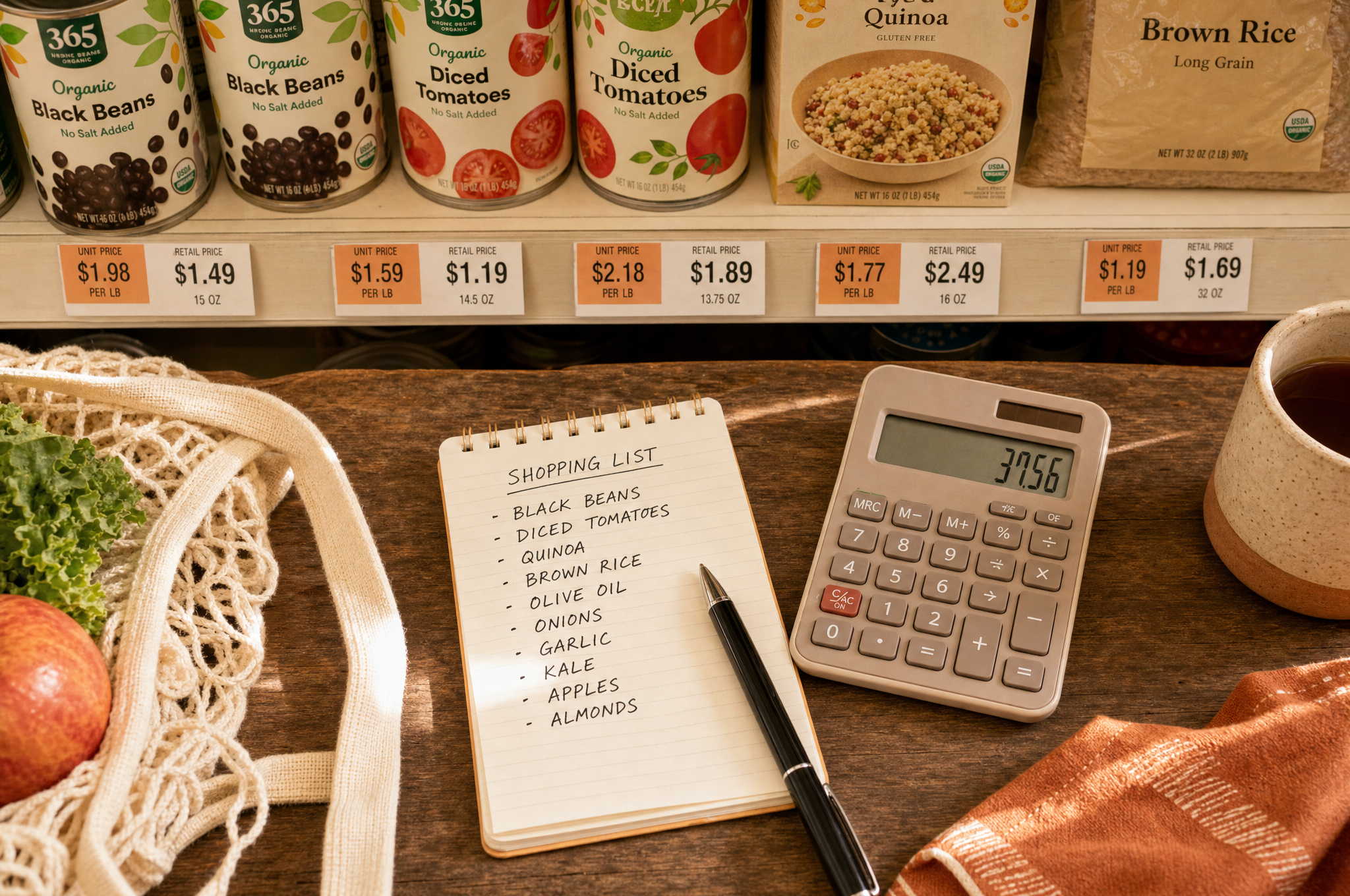
In most U.S. grocery stores, unit prices are displayed on the shelf tag in small print, usually directly below or beside the retail price. They look like this:
Retail price: $4.99 / Unit price: $0.21 per oz
Why unit pricing matters
Without unit pricing, you're at the mercy of packaging. And packaging is designed to deceive you:
- Bigger isn't always cheaper. Sometimes the larger package costs more per ounce than the smaller one. Manufacturers know shoppers assume "bulk = cheaper" and exploit it.
- "Family size" can be a markup. The "family size" version of a product is sometimes priced higher per unit than the regular size, banking on the assumption that bigger means better value.
- Different brands use different package sizes specifically to make comparison difficult. Brand A comes in 14 oz; Brand B comes in 16 oz. Without unit pricing, doing the math in your head while standing in the aisle is painful.
- Sale prices can be deceptive. A "buy one get one free" deal on a smaller package might still cost more per ounce than the regular price of a larger package.
Stores in some countries are required by law to display unit pricing. In the U.S., it's required in only a handful of states. Most stores do it voluntarily, but the information is often in tiny print or inconsistent across departments.
How to read unit price labels
The unit price is usually displayed in the bottom-left or bottom-right corner of the shelf tag, in smaller text than the retail price. It typically looks like one of these:
- $0.21 / oz — 21 cents per ounce
- $2.49 / lb — $2.49 per pound
- $0.03 / ct — 3 cents per count (for items like paper towels or trash bags)
- $0.05 / sheet — 5 cents per sheet (for toilet paper or paper towels)
The key is that the unit must be the same across the products you're comparing. If Brand A is priced per ounce and Brand B is priced per pound, you need to convert one to match the other. (1 pound = 16 ounces.)
The five unit-pricing tricks that cost you money
1. The "bulk illusion"
Larger packages are assumed to be cheaper per unit, so some manufacturers price them slightly higher per unit. Always check — don't assume.
Example: A 6 oz can of tomato paste costs $0.89 ($0.15/oz). A 12 oz can costs $2.49 ($0.21/oz). The bigger can is 40% more expensive per ounce. Buy two small cans instead.
2. The "sale that isn't"
A sale tag doesn't always mean the best unit price. A 20% discount on an overpriced large package might still be more expensive per unit than the regular price of a smaller package.
Example: 24 oz peanut butter "on sale" for $5.59 ($0.23/oz) vs. 18 oz at regular price for $3.49 ($0.19/oz). The smaller jar at regular price is cheaper per ounce.
3. The "different unit" trick
Sometimes shelf tags for comparable products use different units, making comparison harder. One brand of toilet paper is priced per roll; the other per sheet. Always convert to the same unit before comparing.
4. The "convenience packaging" markup
Pre-cut, pre-washed, and individually packaged versions of products carry a massive unit-price premium. A bag of pre-washed salad greens costs 3-4x more per ounce than a head of lettuce. Baby carrots cost 2x more per pound than whole carrots. You're paying for labor — do the work yourself.
5. The "brand shelf placement" game
Name brands are placed at eye level; store brands are on the bottom shelf. The name brand at eye level costs 30-50% more per unit than the store brand two shelves down. Same product, different label, different price.
The Eye-Level Rule
The most expensive products are always at eye level (roughly 4-5 feet from the floor). The cheapest products per unit are on the bottom shelf. Always look down before choosing.
Doing the math yourself
If the store doesn't display unit prices (or you want to verify), the calculation is simple:
Unit price = Total price / Number of units
Example: A 24 oz jar of pasta sauce costs $3.29.
Unit price = $3.29 / 24 oz = $0.137 per ounce
Compare that to a 16 oz jar at $2.49: $2.49 / 16 = $0.156 per ounce. The larger jar is cheaper per ounce.
Your phone's calculator app works fine for this. Or, if you want to track this data long-term, add it to your price book.
Unit pricing across different product types
Different products use different units, and knowing which unit to compare matters:
| Product | Compare by | Why |
|---|---|---|
| Toilet paper | Per sheet or per sq ft | Roll counts are misleading — "mega rolls" vs. "double rolls" aren't standardized |
| Paper towels | Per sheet | Same reason — roll size varies |
| Trash bags | Per bag | But also check bag thickness — a thinner bag at a lower price may be a worse value |
| Cereal | Per ounce | Box sizes vary wildly between brands |
| Cheese | Per ounce | Blocks, shredded, and sliced are priced differently for the same cheese |
| Laundry detergent | Per load | Not per ounce — concentrated formulas mean less volume for the same number of loads |
| Cleaning supplies | Per ounce or per use | Dilutable concentrates may look expensive but are cheapest per use |
The store brand test
Here's an exercise that will change your shopping: next time you're at the store, pick any product and compare the unit price of the name brand versus the store brand. In my experience, store brands are cheaper per unit 90% of the time — often by 30-50%.
Are store brands as good? Usually, yes. Many store brands are manufactured by the same companies that make name brands, in the same facilities, with the same recipes. The name brand you're paying for is packaging and advertising.
Start by swapping one product — store-brand cereal, for example. If your family can't tell the difference, swap another. Over time, you'll find that 80% of store-brand products are indistinguishable from their name-brand equivalents, and you'll save hundreds of dollars per year.
Putting it all together
Unit pricing is a 10-second habit that saves money on every single shopping trip. Here's the workflow:
- Find the product you want.
- Check the unit price on the shelf tag.
- Compare to adjacent sizes and the store brand (which is usually on the bottom shelf).
- Buy the lowest unit price that fits your usage (don't buy more than you'll use before it expires).
That's it. Four steps, ten seconds, consistent savings.
Pair unit pricing with the sale cycle method and a price book, and you've got a complete grocery savings system. Unit pricing tells you which size and brand to buy. The sale cycle tells you when to buy. The price book tracks it all. Together, these three skills can cut your grocery bill by 25-40% without changing what you eat.
The information has been on the shelf tag the whole time. Now you know how to read it.